What Is an AI Sales Stack? A Plain-English Guide for 2026
By David | 7 min read | 27 May 2026
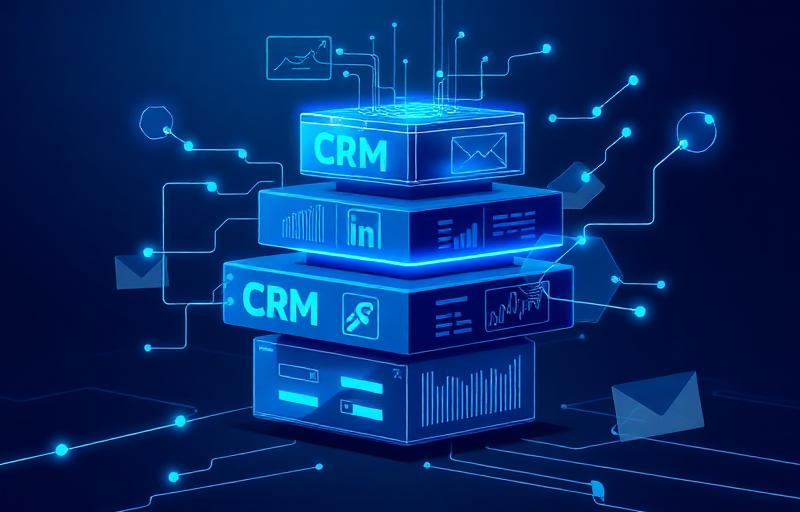
What an AI Sales Stack Is (in One Paragraph)
An AI sales stack is the connected set of AI-powered tools a B2B sales team uses to do the work that used to take humans most of the day: finding the right buyers, reaching out across email and LinkedIn, capturing what gets said on calls, updating the CRM, and surfacing who each rep should contact next. It is not one product. It is not "an AI" sitting on top of your CRM. It is a stack, layered like any other piece of business infrastructure, where each layer does a specific job and feeds the layer above it.
If you take nothing else away: it's a system, not a tool.
Why You're Hearing the Term in 2026
The phrase started appearing around 2023, when the underlying tools (data, deliverability, outreach, call intelligence) all added meaningful AI capability at roughly the same time. By 2026 it means something specific: a coordinated stack of 5-7 tools, not a folder of disconnected SaaS subscriptions.
Three pressures are forcing the conversation now:
- Buyer expectations. Prospects expect outreach that references their business specifically and follow-up that arrives quickly. Manual processes can't deliver both at scale.
- Deliverability rules. Google, Yahoo, and Microsoft now enforce sender authentication. Sending cold email from your main domain without warm-up or DMARC actively damages the business's inbox reputation.
- The rep day. Most B2B sales reps spend around two hours a day actually selling. The rest is admin, research, and CRM updates. AI tooling, properly stacked, gives most of those hours back. See Why sales reps lose so much of their week to admin.
What It Includes (and What It Doesn't)
A complete AI sales stack covers six jobs, in roughly this order. This is the high-level view; the AI Sales Tools 2026 guide is the practical, vendor-by-vendor version.
Includes:
- Email infrastructure. Dedicated sending domains, warmed mailboxes, SPF/DKIM/DMARC properly configured. The plumbing under cold outbound.
- Prospecting and data. Where the list of who to contact comes from, and how it stays current. Account sourcing, contact enrichment, intent signals.
- Outbound execution. Email sequences and LinkedIn outreach running in coordination across multiple touchpoints, triggered by behaviour.
- CRM and pipeline visibility. The system of record. Where every conversation, deal, and forecast lives. The point at which leadership can actually see what's happening.
- Call intelligence. Automatic recording, transcription, and CRM-attached summaries of every sales call. Tools like Fathom, Gong, or Otter.
- Automation glue. The integration layer (Make, n8n, native CRM workflows) that connects everything so reps don't re-type anything.
Does not include:
- A chatbot that closes deals for you. Buyer conversations are still human.
- A replacement for the CRM. The CRM sits inside the stack.
- Marketing automation in the inbound sense. That's a related but separate stack.
- Whatever the loudest vendor in your inbox is selling this quarter.
Common Misconceptions
It's AI that sells for you.
It's not. It's a stack that removes the work around selling so humans have time to do the selling. Every buyer-facing conversation is still a human one.
You need all the layers from day one.
You don't. Most teams should build in order: infrastructure and CRM hygiene first, the more interesting AI layers second. Big-bang rollouts fail predictably. See 7 AI Sales Stack Mistakes.
Bigger stack is better.
The opposite. A stack of six tightly integrated tools beats a stack of fifteen disconnected ones. Every additional tool adds an integration surface, a licence cost, and an adoption problem.
It replaces the CRM.
The CRM is the spine of the stack. Tools that bypass it create the exact fragmentation the stack is meant to fix.
It's only for tech and SaaS companies.
I work mostly with B2B events and media businesses. The same pattern applies, with sector-specific choices covered in The AI Sales Stack for B2B Events and Media.
Do I Actually Need One?
Honest guidance by team size and motion:
- 1 to 2 reps. A full stack is overkill. Get the CRM right, get email infrastructure right, skip the rest until volume grows.
- 5 to 50 reps doing active outbound. This is the band where a stack pays back fastest. Most mid-market B2B businesses sit here. If you're in this band and not building one, you are losing ground to competitors who are.
- Inbound-only motions. Different priorities. Marketing automation matters more than outbound infrastructure.
- Enterprise (50+ reps). Same components, larger buying process and integration complexity. The case for building is even stronger because the cost of doing nothing scales with headcount.
The usual trigger to actually build is one of four moments: deliverability collapsing, a CRM nobody trusts, reps spending the day on admin, or pipeline forecasts that turn out to be fiction. If any of those sound familiar, you've already needed a stack for a while.
Where to Go Next
This guide answers "what is it?" Two natural next questions:
- "How do I actually build one?" Read AI Sales Tools 2026: How to Build a Stack That Actually Works. It's the practical, layer-by-layer build guide with specific tool recommendations and the order they should go in.
- "What does this look like for my sector?" If you're in events or B2B media, The AI Sales Stack for B2B Events and Media is the sector-specific version.
The stack is the system. The tools are the easy part.
---
About the author: David is the founder of AI Sales Stack. Senior sales leader with 23 years driving multimillion-pound growth across B2B media and events. Pioneered AI-enabled sales operations at Terrapinn and Clarion Events, integrating tools across prospecting, outreach, CRM automation, and proposal generation to shorten sales cycles and increase conversion. Currently Commercial Director at Ocean Media Group, where his brief includes embedding AI tools across the commercial function. Writes here about what is actually working in AI-enabled B2B sales, and what is being oversold.
Get new writing as it's published
Join the mailing list for the AI Sales Stack Cheat Sheet and new articles.
Get the Cheat SheetGet insights like this in your inbox
New writing goes out by email when it's published.
Related Posts

The B2B Outbound Engine: A Complete Guide for 2026
Most B2B outbound fails because it's badly built, not because cold outreach doesn't work. This is the complete guide: the 5 components, the mistakes, and how to build an engine that generates pipeline.

How Event Companies Use AI to Grow Sponsorship Revenue
Sponsorship sales is the last B2B function to adopt AI. Here are the five specific ways event companies use AI to grow sponsorship revenue, with realistic implementation phases and costs.

Best Multi-Channel Outbound Platforms for B2B Events and Media Businesses
A vendor-neutral ranked list of the multi-channel outbound platforms that genuinely fit B2B events and media businesses. Honest pros, cons, pricing, and which ones to skip.